
Artificial Cognizance: Advancing to another level of Artificial Intelligence
A saying that I have adopted is that “the sky is no longer the limit,” as the true limit exists beyond our current imagination. It takes our imagination to be sufficiently evoked before we can gain focus on our revolutionary destinations. When we think about the current use of artificial intelligence (AI), we often think about it with respect to systems controlling machines so that they act and react as a human would, based on the expectations of a given system. But this does not necessarily duplicate human intelligence, just intelligence per se in that the response requires certain interpretive knowledge of a given input. Human-level intelligence generally refers to the ability to perform a broad range of intellectual tasks at closely the level of an average human, rather than being highly capable at only one narrow task. Today’s systems are generally called narrow AI: while they can be highly capable, their competence is limited by the types of problems, data, and interfaces they were designed and trained for.
Enter Artificial Cognizance (AC)
For an artificial cognizance (AC) system we are necessarily talking about mimicking human intelligence. This does not dictate the level of human intelligence; however, it does imply a certain level of intelligence which demonstrates cognizance. Artificial cognizance is a sub-field of AI that extends beyond the limited responsiveness in which narrow AI is generally applied. Artificial cognizance suggests a machine capacity to “know,” interpret its situation, form internal representations, assess its own information or state, and infer proper meaning to satisfy requests. The lack of this capacity in current AI systems leads to explanations of why they are unable to follow extended conversations without getting confused. It’s one thing to follow the meaning of a specific command or question. It’s yet another to follow a dialog or story while extracting information
from it.
Human cognizance requires an inherent interpretation of the world and immediate environment, and the inputs or stimuli encountered in them. One example of this is being able to follow a dialog and infer meaning from the information given. Consider a dialogue that includes the statements:
“Chicago had snow yesterday. It came down for hours. It will continue today. Linda no longer wants to do the magazine’s photo shoot on a Chicago River bridge, but in the Tower instead.”
Not only are the references of “it” and Linda’s reason for changing the photoshoot location easily understood by humans, but to most Chicagoans, it is also clear that she is referring to the landmark Willis (formerly Sears) Tower. Thus, artificial cognizance must be able to draw proper relations, both direct and indirect, between words and situations. AC should understand things about the world, and be able to infer new information and use that information to react or respond to questions or situations. This is something that implies a level of thought that qualifies as being cognizant or aware of one’s situation.
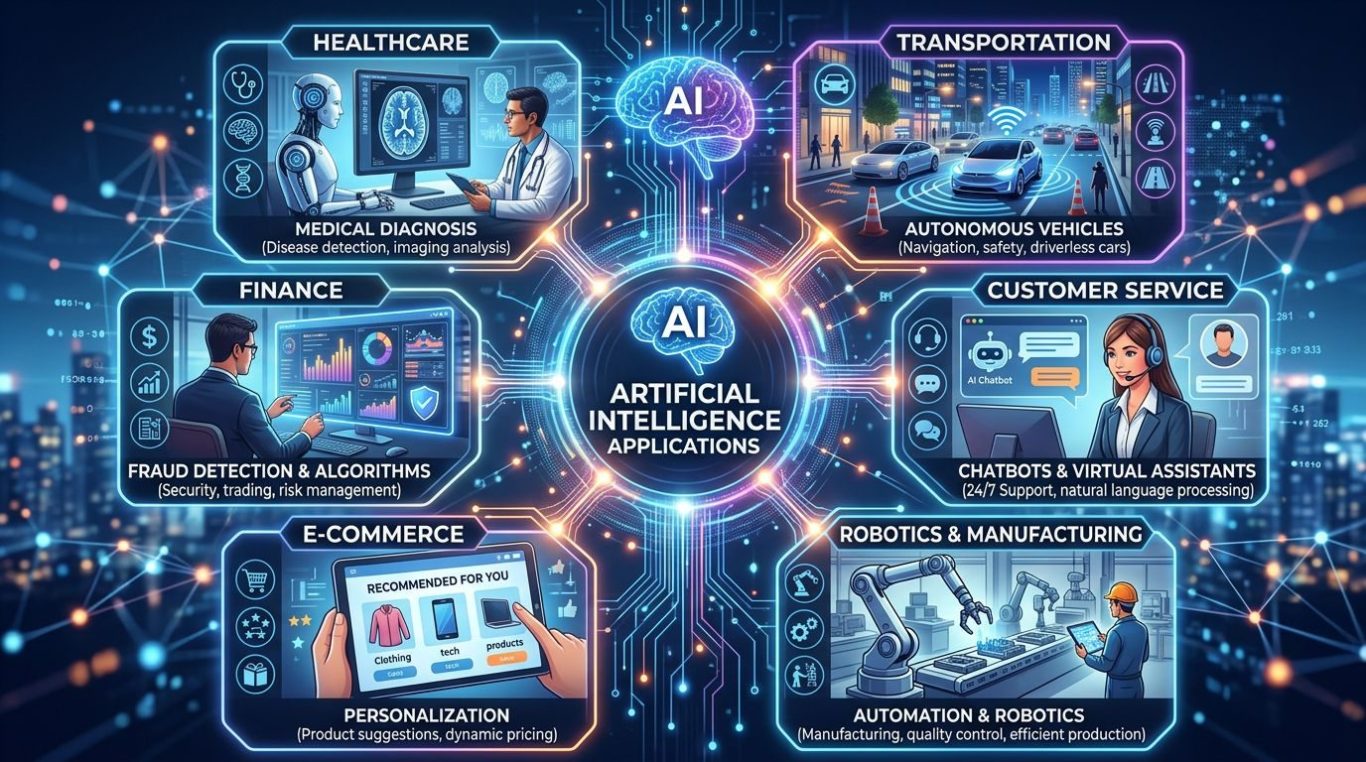
Current applications of AI vs AC
We think of human intelligence as being able to learn and adapt. Another difference between the requirements for AI in general and the more refined requirements for artificial cognizance is that while AI in general can show an understanding of a given situation and certain information passed on to it, it may have limited or no adaptability. Unexpected information is often categorized as erroneous input and left unprocessed.
While AI has generally been applied in systems to allow adaptability to certain ranges of input, it is not often required that the system be able to learn to adapt to new input outside of strict constraints.
We are often confronted with AI today via customer service and support calls where a computer asks specific questions and will except specific answers from you. These systems represent a type of closed intelligence system. The input that they are programmed to accept and the responses that they will provide are determined from a confined list. This list is built from the typical answers that would be expected in response to the specific information required for the system to provide the service it was designed for. This exhibits a narrow degree of intelligence.
But when the reason for your call falls outside of the call reasons in the list, you fall into the “other” category and are transferred to a live agent. The implementation of AC can improve the responsiveness of AI customer service systems by better assisting calls that currently fall into the other category.
The above system may be able to be modified to respond to more inputs by having more types of data/objects added to its knowledge base, but it is often not able to dynamically do this on its own. The degree to which a system learns will always be limited unless the system is designed to simulate cognizance, in which new information is assimilated with respect to the system’s existing knowledge and not just added to the system as additional raw data to filter through. Thus, the new info will have a meaningful relationship defined in conjunction with the existing system info to enhance the system’s depth of knowledge and not just the amount of knowledge available.
What does the implementation of AC offer?
This “cognizance” will allow an AI system to learn and adapt without restrictions, and thereby approach intelligence as we think of it with respect to humans. Many AI systems only apply the processes of assimilation of data, understanding of data, adaptability to input, and responsiveness to input to a limited degree and in a linear fashion with emphasis often being on one process over the others. The apparent intelligence exhibited is task related. Therefore, the system is evaluated by how well it performs the target behavior and not by whether it can autonomously acquire and use a broad open-ended set of human competencies.
Programmed cognizance removes the boundaries that so many of our programs today have, thus allowing the program to learn new terms based on the terms it understands already. This is not unlike the way that we learn ourselves. As children we have certain terms explained to us, then, as we encounter and experience more things in life, we define these things using the terms that we already know. As we understand more terms, each new term increases our ability to understand even more terms. This approach expands the boundary with which AI can exhibit human intelligence since it is the ability to understand and adapt our responses and behavior that makes us intelligent.
Implementing such a cognizance requires a core inference unit that can recognize and define things in different categories and appropriately correlate them, similar to the way that humans do. Now, this sounds like another AI sub-field called machine learning (ML). But machine learning, by contrast, is a narrower set of techniques for learning statistical patterns from data and using them for prediction, classification, and decisions. AC overlaps ML but it does not sit within it. AC will represent a type of ML and inference.
Where does AC stand today?
There are some systems today that take this cognitive need into account. But it is still done in a narrow capacity. In addition, most techniques today still rely on extensive sampling of examples of what they’re simulating understanding of. A true AC system will rely more on logical relationships among the meaning of words than on patterns recognized from a multitude of examples. Performance benefits of developing an AC system are that it will expectedly reduce the amount

of system resources needed to teach/train and enable the functionality of many AI systems. Advanced cognitive inference procedures will replace scrutinizing sometimes tens of thousands of training samples to find a sufficient pattern to form an answer from.
Artificial cognizance represents a critical component in the advancement of artificial intelligence. As the development of AC is in its infancy, strict requirements and supporting development architectures are not yet defined. This site will discuss defining artificial cognizance (AC) as well as contrasting it with other AI sub-fields like machine learning, artificial cognition, artificial consciousness and the ultimately sought after artificial general intelligence (AGI). In addition, the site will venture to define and declare requirements for achieving artificial cognizance.
Prof. F.B. Kato
October 1, 2026